
Explore these manufacturing technologies that transformed the world by improving production speed, precision, automation, and industrial innovation.
The world of manufacturing has come a long way in recent decades.
Throughout history, it has evolved from factory settings that were completely reliant on human workforces to near-autonomous, machine-powered settings that create advanced technologies with extreme precision.
Throughout history, each advancement in manufacturing has driven up standards for speed, specificity and scalability, giving businesses and wider industries the means of smashing through their previous limitations and growing to a level that had only previously been dreamt of.
These new factories bring together automation, data analysis, and cutting-edge tech with precision-controlled production environments to create high-tech products, like chips and smartphones.
In this article, we’re going to take a closer look at the tech that builds our tech and has given businesses the engine needed to launch them into the stratosphere.
Advanced robotics
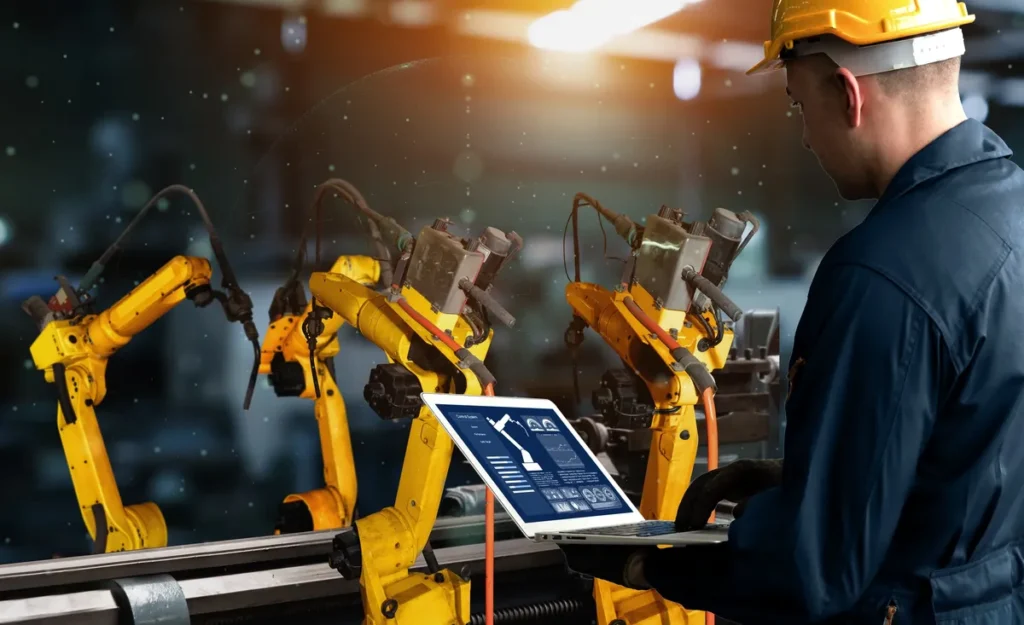
Industrial robots have been replacing many of the world’s manual labour jobs in the manufacturing industry since the late 20th century.
They changed the game by being able to carry out consistent, repeatable motions within these environments.
In the early days, they quickly rose to prominence because manufacturers were impressed with the potential for faster assembly processes and higher quality standards.
Soon enough, robotic arms were being used for welding and lifting, and quickly became popular within the automotive industry, where these robots could be used to precisely construct engines and gearboxes.
Thanks to robotics, production speed has greatly improved, while the uniformity of products is maintained across enormous volumes.
As these systems have continued to advance into the modern age, manufacturers have kitted them out with improved sensors, machine vision, and introduced new ‘collaborative’ robots into production lines that work with people.
Often known as ‘cobots’, they support workers by taking over the more repetitive tasks, allowing workers to be more productive by focusing more on oversight and quality control.
Ultrapure Water Systems
This lesser-known modern technology is one of the most important innovations in the tech industry in the past 20 years, as it has enabled the mass production of chips and allowed tech startups, no matter the budget or scale, to get off the ground.
As an example, Ultrapure water gets its name because of its uncompromising purity, after it goes through an extensive purification process that removes impurities in the form of dirt, dissolved minerals, and gases.
As a result, its purity goes far beyond that of ordinary ‘clean’ drinking water and enables its use in manufacturing environments.
Ultrapure water plays a vital role in building semiconductors at every stage of the process. That’s because the silicon wafers that form the basis for the chips need cleaning hundreds of times during the manufacturing process.
That’s because even the tiniest impurities can contaminate the chip, stopping it from conducting electricity and damaging circuits.
But fortunately, the ultrapure water removes dirt particles and chemical residues – all while keeping the integrity of the structure itself.
After that, these chips will be used for consumer electronics, medical equipment, transport systems, and more.
AI: Intelligent manufacturing
In recent years, we’ve started to see the early stages of an AI revolution which promises to nosy its way into every aspect of our society, looking for ways to improve the quality of life for consumers and workflow efficiency for businesses.
In manufacturing, AI’s biggest impact so far has been in its ability to deliver accurate, data-driven insights into the manufacturing process that can improve operational efficiency by picking up on weaknesses, defects, and optimising production schedules.
That’s because AI can comb through gigabytes of data in seconds.
Another practical benefit of AI in this particular arena is predictive maintenance, which is all about knowing exactly when machinery needs maintenance checks.
ANd that’s because certain AI systems are capable of checking the temperature, pressure, and performance of machinery to predict breakdowns before they happen.
Overall, this approach will naturally result in fewer breakdowns, meaning fewer interruptions to the manufacturing process, as well as longer lifespans for each piece of machinery.
What’s more, AI forecasting tools are changing the way that businesses manage supply chains. These tools are being used to analyse market trends, demand from customers, and data on inventory.
As a result, manufacturers are now able to change production scales more dynamically, reducing excess inventory while, at the same time, maintaining product availability.
Additive manufacturing and 3D printing
Traditionally, manufacturing methods have gotten rid of materials by cutting and drilling. It’s not exactly the most efficient way to use the resources you have when so many of them end up in the bin.
Additive manufacturing takes a more efficient, precise approach that is more akin to a sculptor gradually removing and shaping clay until their sculpture is complete. This is thanks to digital design files that let engineers create complicated structures with incredible levels of precision.
3D printing like this started out life as a quick way to prototype within hours of conceptualising, as opposed to waiting weeks on end for a designer to construct something.
This initially helped to speed up development cycles across a wide variety of different industries, like healthcare, aerospace, and consumer electronics.
As these printing technologies have continued to advance, additive manufacturing became capable of supplying full-scale production lines.
Manufacturers are now able to print full-scale metal, plastic, and ceramic parts – perfect for lightweight engine parts in planes and cars.
Main takeaways
So many businesses are reliant on manufacturing technologies that they aren’t familiar with.
Who knows, you might not be taking advantage of the technology that is available nowadays that could speed up your processes, lower costs on damaged machinery, or improve quality standards with improved data insights.
The manufacturing of old has come and gone, now in its place, you can find additive manufacturing, ultrapure water cleaning, artificial intelligence, and advanced robotics.
These innovations of years gone by are now foundations for the future; from here, who knows just how manufacturing will continue to advance?

BusinessPulse‘s professionals have extensive experience in Business and other life-changing sectors in the USA and beyond, sharing their experience and providing helpful tips and advice.